Client
Role
Industry
Year
Figma, Miro, Notion, Maze
Tools
Running is one of the most social activities that most people do alone. Group runs exist, but finding people who match your pace, schedule, and comfort level is harder than it should be. Existing platforms like Strava and Nike Run Club are built around performance tracking — they're great at measuring runs, but they don't do much to help you find someone to run with.
Flyve's premise was different: build a community-first platform where connection is the product, not a secondary feature. That meant solving for inclusivity, safety, and flexibility in equal measure — and making the whole experience light enough that casual runners would actually use it, not just download it.
Research revealed that runners don't have uniform needs. Some wanted structured recurring meetups; others needed the freedom to decide day-of. That range shaped the core design challenge: build a platform that works for both without making either feel like a compromise.
Competitive analysis of Strava, Nike Run Club, and Meetup pointed to consistent gaps — particularly around safety, low-barrier participation, and the kind of inclusive social environment that welcomes beginners rather than making them feel outpaced. These became the design priorities.
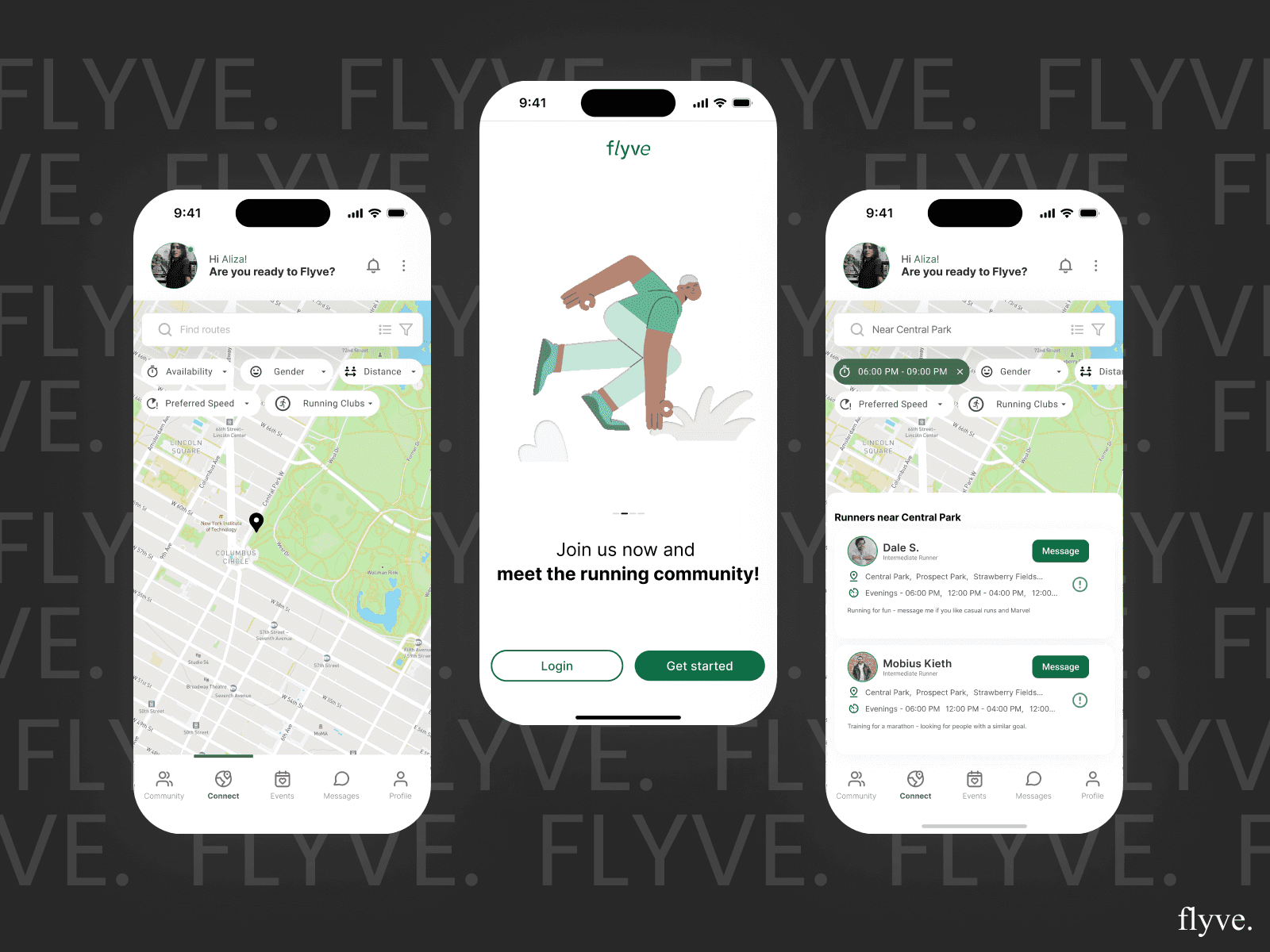
User flows were built around minimal friction from the start. Onboarding was personalised to surface runs based on pace, availability, and goals, so new users saw relevant options immediately rather than an empty feed. Profile design was calibrated carefully — enough detail to assess compatibility, not so much that it felt like a commitment.
Safety was treated as a first-class feature, not an afterthought. Masked location sharing and recommended public meeting points addressed a concern that came up consistently in research, particularly among newer runners and women. These weren't bolt-ons — they were structural decisions that shaped how the whole platform handled location data.
Usability testing with a working prototype surfaced two specific refinements: clearer cues around group run participation, and simpler filtering by pace and distance. Social features like milestones and run streaks were also recalibrated — dialled back from gamified to genuinely encouraging, which landed better with users who were motivated by community rather than competition.
Flyve landed as a platform that feels meaningfully different from what's already out there — less competitive, more welcoming, and built around the actual social mechanics of running rather than fitness metrics. Users in testing specifically noted that it felt more inviting than existing tools, which was exactly the positioning it needed.
The project is a good example of what happens when safety and inclusivity aren't treated as edge cases — when they're built into the core experience from the first research session, they end up making the product better for everyone.